Field: Defense Systems, Aviation, Space Engineering, Optronics, and Ballistic Protection
Technologies Used: Stereolithography (SLA) Technical Ceramics 3D Printing (Top-Down Equipment: Ceramaker, C101 EASY LAB, C1000 FLEXMATIC, C3601 ULTIMATE)
About the Project
With the tightening geopolitical context and accelerating technological progress, the defense sector worldwide is seeking solutions to strengthen operational capabilities and strategic autonomy. Technical ceramics are becoming a strategically important material in this sector due to their exceptional physical and chemical properties: low density (lightness), high hardness, wear resistance, chemical inertness, heat resistance, and transparency to electromagnetic waves.
Engineering and Manufacturing Solutions
Traditional ceramic processing methods are complex and limit the ability to create complex geometries, so 3DCeram has adapted advanced SLA 3D printing technology:
Unique Top-Down SLA Technology: Unlike Bottom-Up systems, this process enables the printing of larger, heavier, and monolithic ceramic parts without seams or additional joints, which is particularly important for defense systems requiring high structural integrity.
Wide Range of Materials (3DMix): Depending on the application, certified ceramic materials are used: aluminum oxide, zirconium oxide, aluminum nitride, ATZ, spinel, silicon dioxide, and silicon carbide (SiC).
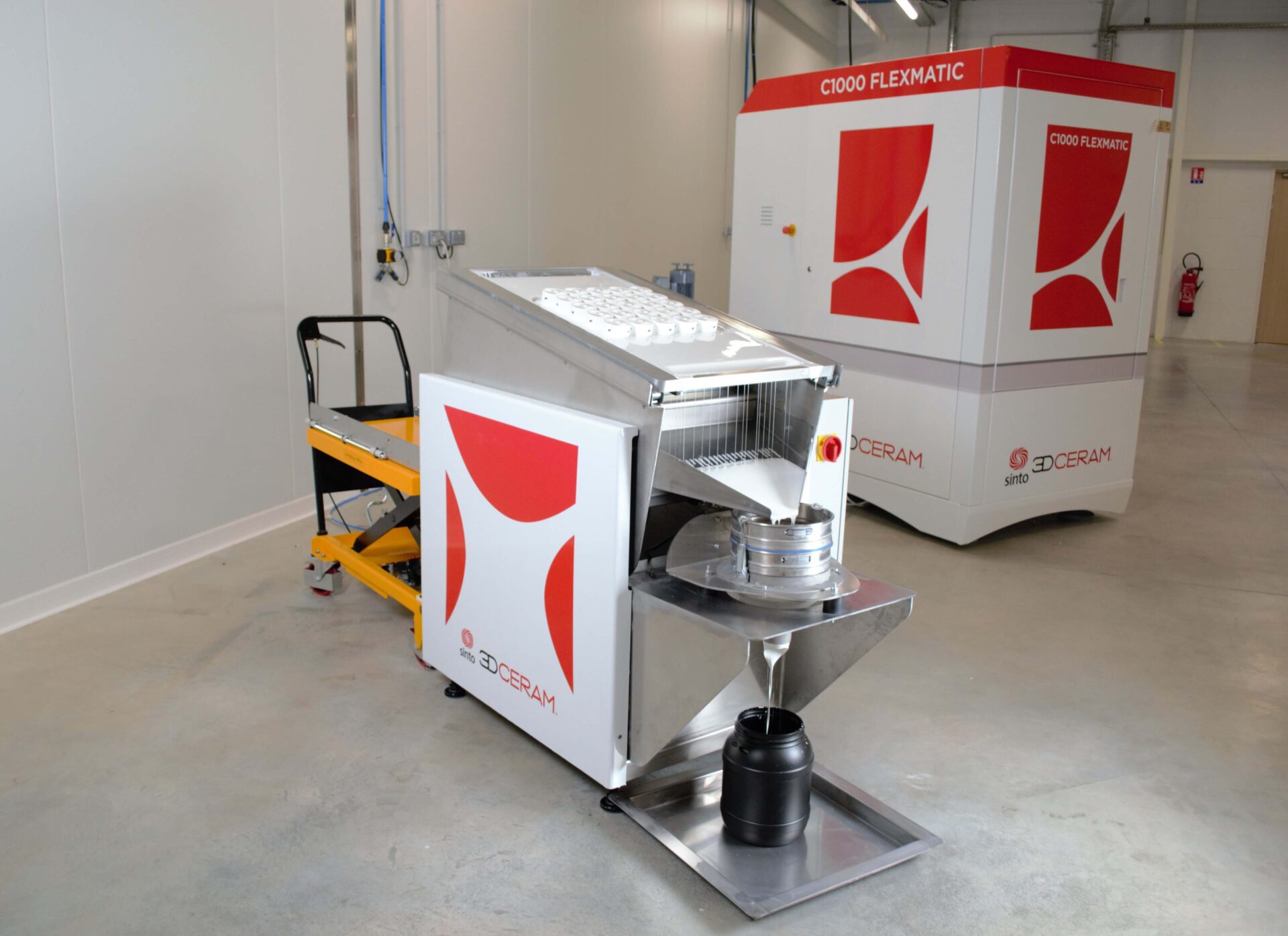
High-Precision Manufacturing Equipment: Industrial 3D printers with UV lasers are used (e.g., C1000 FLEXMATIC with a $320 imes 320 imes 200 ext{ mm}$ platform or C3601 ULTIMATE with a $600 imes 600 imes 300 ext{ mm}$ platform), enabling laser spot accuracy of approximately $60 mu ext{m}$.
Artificial Intelligence Integration: The implemented CERIA AI system helps shorten the development cycle, facilitates technology transfer, and optimizes production costs.
Results Achieved
Weight Reduction and Performance: Replacing metal components with ceramic ones in armored vehicles, aircraft, or missiles has significantly reduced fuel consumption or increased payload capacity.
High Resistance to Extreme Conditions: Manufactured parts do not melt, do not corrode, and maintain their properties at extreme temperatures, suitable for hypersonic engines, atmospheric entry systems, and ballistic protection.
Wave Transparency: Electromagnetic wave transparency without significant attenuation has been ensured, essential for radar radomes and advanced communication systems.
Supply Chain Sovereignty: The ability to manufacture critical, individually customized, and confidential ceramic components locally ensures complete supply chain independence.
Do you have a similar project or idea? Contact us to discuss possible solutions!